Committed to Eye Care with Compassion, Technology and Competency

Committed to Eye Care with Compassion, Technology and Competency
11/13/2026
Many people with diabetes see well, feel well and assume their eyes must be fine. That assumption is the main reason diabetic eye disease is found late. Early diabetic retinopathy, damage to the tiny blood vessels of the retina, usually causes no pain, no redness and often no change in vision.
So how often should you have your eyes checked? Most people with diabetes need a dilated retinal examination at least once a year, but the right schedule depends on the type of diabetes, how long you have had it and what the last examination showed. This guide sets out the usual schedule for each situation and what the visit involves.
A 2022 systematic review of ten Indian studies estimated that about 16 in 100 people with diabetes had some degree of diabetic retinopathy. Many of them would not have known. The practical meaning is that a normal-feeling eye proves little. By the time blurred vision, floaters or dark patches appear, the disease may already be advanced, and treatment is then aimed at holding on to the vision that remains. Screening finds the changes while treatment is still most effective.
These intervals follow commonly used international guidance, and your ophthalmologist or diabetes doctor may change them for your eyes.
Some factors raise the risk of progression and justify closer follow-up:
If any of these apply, mention them when you book.
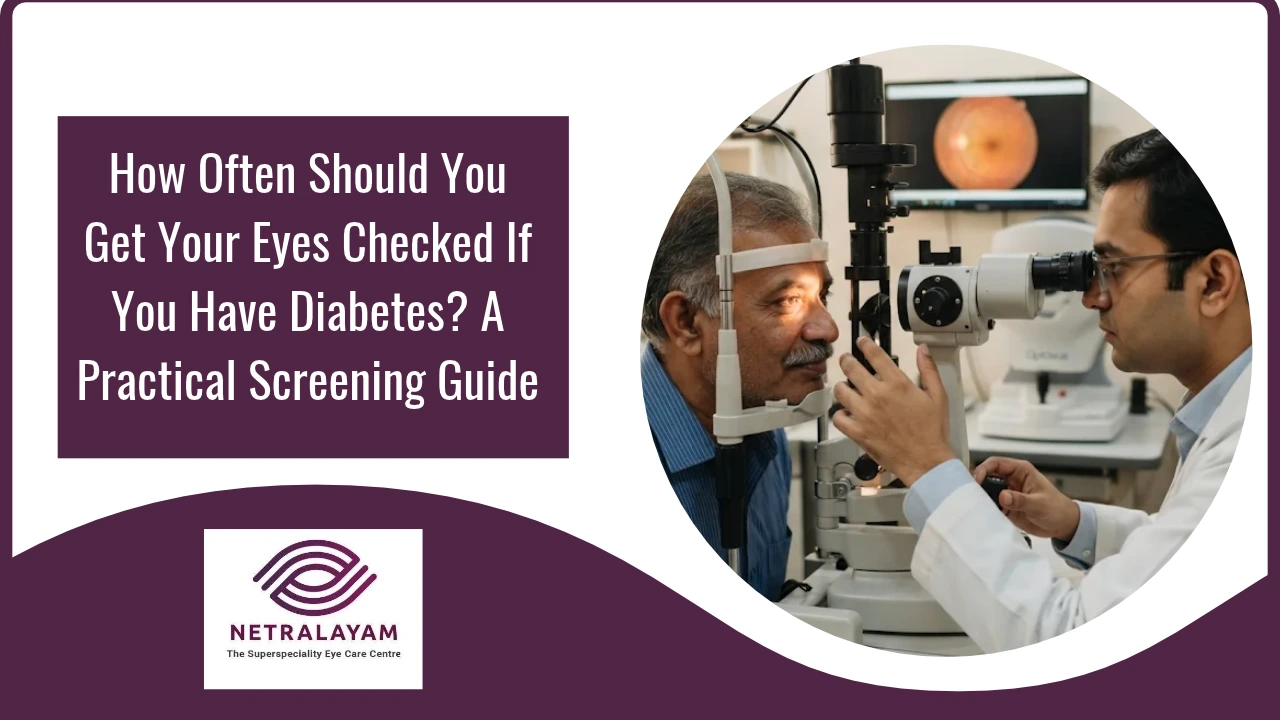
A diabetic eye check is more than a reading chart. Typically, it includes:
1. Vision and eye pressure checks, to catch glaucoma and to record a baseline.
2. Dilating drops, which widen the pupil so the retina can be examined fully. Expect blurred near vision and light sensitivity for a few hours, so avoid driving yourself.
3. A dilated retinal examination, and often retinal photographs, to look for tiny bleeds, fluid leaks, abnormal vessels and swelling.
4. An OCT scan, which produces a cross-section of the macula and shows swelling that may not be visible on examination. We explain how this works in our guide to OCT scans.
5. Fluorescein angiography, only if needed. This dye test is used when the retina specialist needs to see the blood flow in detail, not for every patient.
No single test settles everything. The examination, photographs and scan are interpreted together, along with your sugar and blood pressure history.
Children and teenagers with type 1 diabetes usually begin screening around puberty or after a few years of diabetes, whichever the doctor advises. Anyone planning cataract surgery should tell the surgeon about diabetes, because the retina needs to be checked before and after the operation. People starting insulin or a new treatment after a long period of high sugar should also let the eye doctor know, so that the retina can be reviewed at a sensible time. A missed year is not a disaster, but it should not be allowed to become two, because retinal changes can progress quietly in the meantime.
Bring your medicine list, recent HbA1c and blood pressure readings, and previous eye reports. Tell the doctor if your vision fluctuates through the day, as this can be related to sugar levels rather than the eye alone. Our guide on how diabetes affects your vision explains the symptoms to watch for between visits.
Do not wait for your scheduled visit if you notice a sudden loss of vision, a shower of new floaters, a dark curtain or shadow across your vision, or sudden distortion of straight lines. These need same-day assessment.
If you have diabetes and have not had a dilated eye examination in the last year, this is the time to book it. Netralayam's vitreo-retinal services cover retinal examination, OCT and treatment where needed. Book an appointment at Netralayam in Kolkata for a diabetic eye check and a follow-up schedule suited to you.
Yes. Good control lowers the risk but does not remove it, and early retinopathy has no symptoms. Your ophthalmologist can advise whether yearly or less frequent visits suit you.
You can combine them, but a spectacle test alone is not a retinal screening. A dilated retinal examination is what detects diabetic changes.
It is safer not to. Vision may be blurred and light-sensitive for some hours, so bring someone with you and carry sunglasses.




Leave a Reply Cancel reply