Committed to Eye Care with Compassion, Technology and Competency

Committed to Eye Care with Compassion, Technology and Competency
9/18/2026
A red, watering, uncomfortable eye can mean more than one thing, and two of the most common causes, a corneal abrasion and pink eye (conjunctivitis), are often mistaken for each other. A corneal abrasion is a scratch to the clear surface of the eye, usually from an injury, while pink eye is inflammation of the membrane covering the white of the eye, usually from infection or allergy.
They can look similar at a glance, but the two are managed quite differently, so telling them apart matters more than the redness alone might suggest. Here are the differences worth knowing, and when to see an ophthalmologist rather than wait it out.
Cause is the clearest starting point. A corneal abrasion comes from physical injury, such as a fingernail, a foreign speck, a poorly fitted contact lens or vigorous eye rubbing. Pink eye instead comes from a virus, bacteria or an allergic reaction affecting the conjunctiva, not the cornea itself.
From there, several features tend to separate the two:
In practice, a corneal abrasion often announces itself immediately: a sudden stabbing sensation, streaming eyes and an urge to keep the eye shut, frequently traced to a specific moment, a branch, a fingernail, a lost contact lens. Pink eye tends to build more gradually, starting as itching or a gritty feeling that worsens over a day or two rather than arriving all at once.
The trouble is that overlap is real. Both can cause redness, tearing and general discomfort, and a mild abrasion can feel more like irritation than an injury, while a severe conjunctivitis can genuinely hurt. Because the two can look identical from a mirror, appearance alone is not a safe way to tell them apart, which is exactly why a professional eye examination, not a home guess, is the reliable next step.
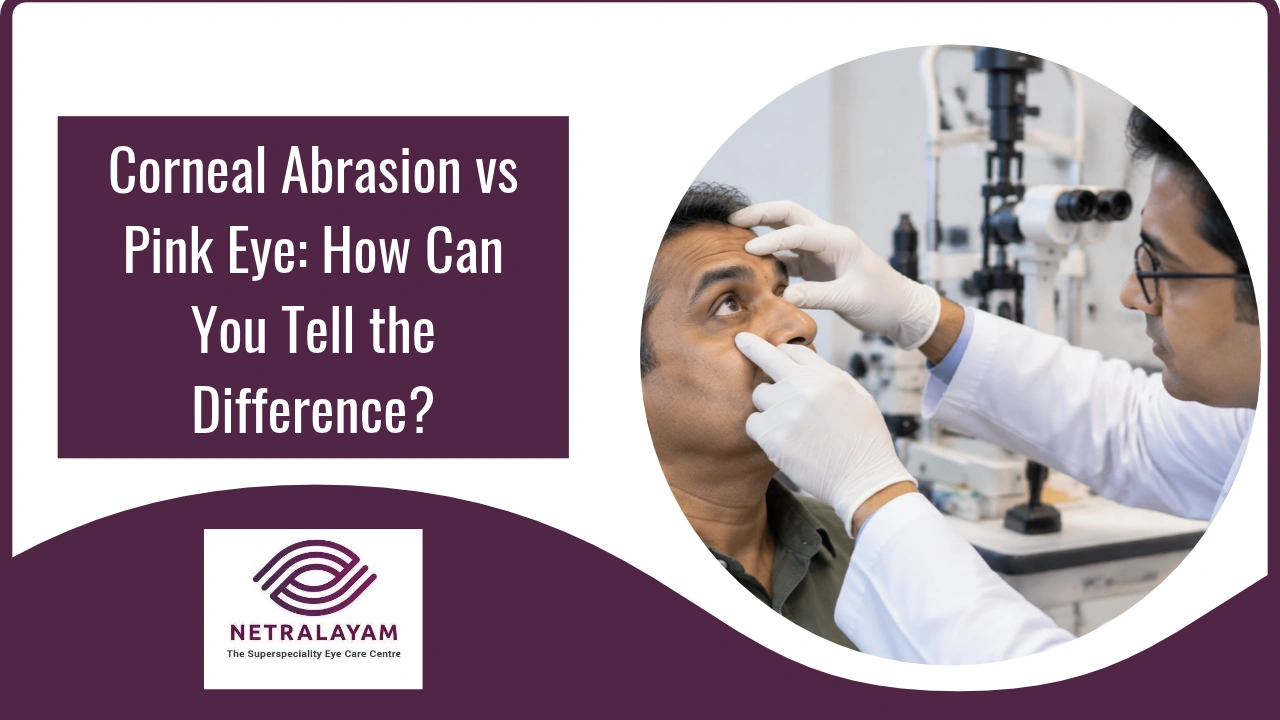
Distinguishing them with confidence needs more than a symptom checklist, it needs the specific tools an eye examination uses. If a corneal abrasion is suspected, your ophthalmologist typically uses fluorescein staining, a dye combined with a blue light that lights up any break in the corneal surface, making even a small scratch clearly visible.
If pink eye is suspected instead, the exam focuses on the conjunctiva and the type of discharge present, since a bacterial infection typically produces thicker, more persistent discharge than a viral or allergic one, which helps guide treatment without necessarily waiting for lab results.
1. Corneal Abrasion Treatment: Most minor corneal abrasions heal within a day or two on their own, since the corneal surface regenerates quickly. Your ophthalmologist may still prescribe antibiotic drops or ointment to reduce infection risk while it does, and will usually advise against wearing contact lenses or rubbing the eye until the surface has fully healed. For an eye injury more broadly, an ocular trauma assessment covers this alongside other injury types.
2. Pink Eye Treatment: Treatment for pink eye depends on the cause. Viral conjunctivitis usually clears on its own with supportive care, bacterial conjunctivitis may need antibiotic drops, and allergic conjunctivitis is generally managed with antihistamine drops and avoiding the trigger. Starting antibiotics for a viral or allergic cause will not speed up recovery and is best avoided, which is one more reason an accurate diagnosis matters more than starting treatment immediately.
See an ophthalmologist promptly if you notice:
These are worth treating as more urgent than ordinary redness, since a deeper or infected corneal injury can occasionally affect the cornea's clarity if it goes unmanaged, and a painful red eye in a lens wearer in particular should not wait for a routine appointment slot.
Redness by itself cannot tell you which of these two you are dealing with, since a scratch and an infection can look remarkably alike from the outside. Book an appointment at Netralayam to examine the eye directly, confirm which one it is, and treat it accordingly.
Yes, especially in the first day, before the sharper pain of an abrasion or the itching of conjunctivitis has fully set in, which is exactly why an examination beats a home comparison.
Usually, yes, though pain varies enough between individuals that it should not be the only sign relied on, since a deep abrasion and a severe conjunctivitis can occasionally feel similarly uncomfortable.
Most small abrasions heal within a day or two, though larger or deeper scratches can take several days and may need a follow-up check to confirm the surface has healed cleanly.
Not typically. Pink eye is usually mild to moderately uncomfortable, so significant pain is a signal to look for another cause, such as a corneal injury, rather than assuming it is simply conjunctivitis.
Redness alone rarely is, but redness combined with severe pain, vision changes, light sensitivity or a suspected foreign body is worth same-day evaluation rather than a routine booking.




Leave a Reply Cancel reply